Richard Serra
March 27, 1999 – October 17, 1999
One of the most preeminent sculptors of the twentieth century, Richard Serra has long been acclaimed for his challenging and innovative work which emphasizes the process of its fabrication, characteristics of materials, and an engagement with viewer and site. As an emerging artist in the early 1960s, Serra was a participant in the changing nature of artistic production. He and the Minimalist artists of his generation turned to unconventional, industrial materials and began to accentuate the physical properties of their work.
Relieved of its symbolic role, freed from the traditional pedestal or base, and introduced into the real space of the viewer, sculpture took on a new relationship to the spectator whose phenomenological experience of an object became crucial to its meaning. Viewers were encouraged to move around-and sometimes on, in, and through-the work and encounter it from multiple perspectives. Over the years Serra has expounded further on this spatial and temporal approach to sculpture by activating and engaging the spatial field between subject and object. For the past two decades Serra has focused primarily on large-scale, site-specific works which create a dialogue with a particular architectural, urban, or landscape setting and in so doing redefine that space and the viewer's perception of it. The current exhibition presents Serra's Torqued Ellipses, the artist's most recent rumination on the physicality of space and the nature of sculpture.
Born in San Francisco in 1938, Serra earned Bachelor and Master of Arts degrees in English from the University of California in Santa Barbara, then a Master of Fine Arts degree from Yale University in 1964. He spent the following two years studying in Paris and Italy before settling in New York in 1966. In 1967 and 1968 the artist developed a list of infinitives, such as "to scatter," "to roll," "to prop," "to cut," and "to bend," which describe many of the processes the artist would employ throughout his career, either using his own hands or industrial methods of fabrication. Early on, Serra made works that assigned primary significance to process. Exploiting unusual materials such as rubber, which he hung in strips on gallery walls, and molten lead which he famously hurled into the angle between wall and floor, Serra placed particular emphasis on the process by which materials themselves are formed as well as the way they react to external conditions such as gravity or temperature.
Finding that these early works maintained too much of a traditional pictorial figure-ground relationship with the ground or wall, Serra began to move in a different direction in 1969. With his now-iconic One-Ton Prop (House of Cards), which consists of four lead plates kept vertical by the force of their own weight as they lean against one another, Serra began to focus on the tectonic nature of sculpture. As with the process works, the nature of its construction remained visible. In a series of prop pieces, Serra made manifest the principles of balance and gravity and their elemental role in sculptural production. Given both the pliable nature of lead and its great weight, however, these works are charged with tension; the apparent instability of the elements produce a conflict between a fear of the collapse of the piece and comprehension of the laws of physics.
Since 1970 Serra has worked predominately in steel, a material commonly associated with architecture and engineering, disciplines the artist has often looked to for an understanding of the origins of sculpture. With the introduction of steel as medium, the scale of his works increased dramatically. They could no longer be considered discrete objects; their meaning and constitution cannot be separated from environment and cannot be discerned by the viewer as a whole without a peripatetic examination. This interest in a perceptual experience contingent on movement through space and time and, in Serra's words, on "memory and anticipation," was kindled by the artist's introduction to the Zen gardens of Kyoto during a six-week visit to Japan in 1970: In the Zen garden, there is no fixed view. The influence of the trip manifested itself in many subsequent works, including those presented here, whose exterior view gives no clue to the interior form.
Serra's ongoing series of Torqued Ellipses, eight of which are included in the exhibition, remain tied to the artistic vocabulary Serra has developed over the past thirty years, but also reflect a significant departure. While the physicality of space has long been a concern for the artist, in these new works space has become his material. As Serra himself describes it:
In most of the work that preceded the Torqued Ellipses, I was forming the space in between the material that I was manipulating, and I was focused on the measure and placement of the work in relation to a given context. In these pieces, by contrast, I was starting with the void, that is, starting with the space, starting from the inside out, not the outside in, in order to find the skin*.
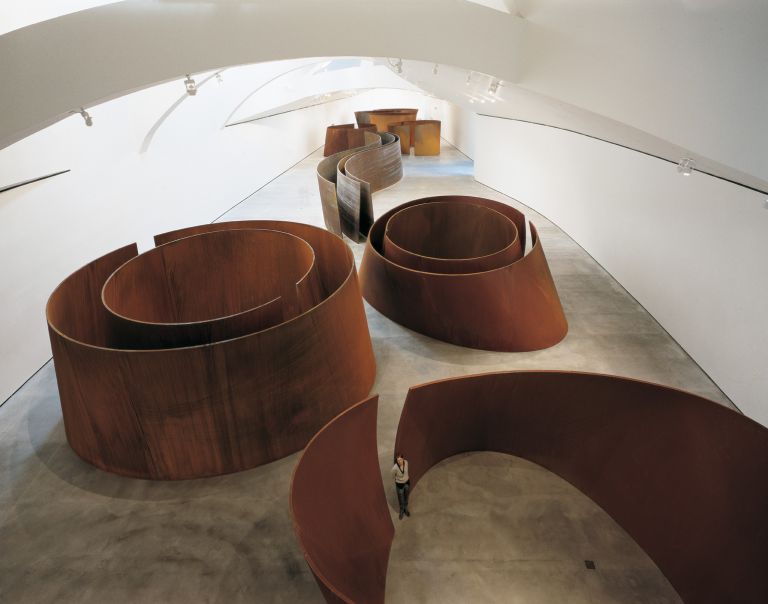
The design of the pieces, which the artist calls "vessels," is based on two perfect and identical ellipses that overlap at an angle. The steel is bent to act as a skin that encloses the elliptical voids and rotates as it rises from the bottom to the top ellipse. The curved planes of steel lean in and out in a continuum, creating a form not seen before in architecture or sculpture. Serra's conception of the series was inspired in part by a visit to Borromini's San Carlo alle Quattro Fontane in Rome, whose elliptical dome rises out of the church's central space like an oval cylinder. Serra was prompted to explore how this form might be turned in on itself. To work out the problem, the artist and an assistant made models using two small wooden ellipses joined with a dowel that they then enveloped with a continuous lead sheet. Using the same principles, a software program called CATIA, originally designed for aerospace technology, was able to produce continuous-line drawings of the volume and determine the angle of the bend required of each S-curved steel plate used for the actual works which weigh approximately twenty tons each and measure up to thirteen and one half feet high. (Each ellipse consists of two to three plates.) After a lengthy search Serra was able to find two steel mills capable of fabricating the complex works. Three of the ellipses now installed were fabricated at the Beth Ship shipyard and mill in Maryland, and five at the Pickhan Umformtechnik GMBH in Siegen, Germany. Evident in the differing patinas of the steel, Serra oiled certain of the pieces, while most were allowed to rust naturally.
These sculptures are ideally suited for the Guggenheim Museum Bilbao's "Fish" gallery (designed by Frank Gehry using the same CATIA program Serra would later consult). The Ellipses are shown with Snake, 1996, a work the artist made specifically for the Guggenheim Bilbao. Comprising three serpentine ribbons of steel made up of six sections (two per curve), Snake totals 31.65 meters in length, reaches 4 meters in height and is over 6.8 meters wide. The sense of motion and instability captured in the tilted, snaking passages is echoed and magnified in the Ellipses, which continue Serra's interest in curvilinear shapes, but with an added twist. In Snake, the individual steel plates tilt in one direction or the other; in the Ellipses, one plate can be at once concave and convex. There is, in fact, no discernable vertical line in the structure. These new forms seem to defy gravity and logic, making solid steel appear as malleable as felt. Shifting in unexpected ways as viewers walk in and around them, these sculptures create surprising experiences of space and balance and provoke a dizzying sensation of solid steel and space in motion.
This exhibition was organized by The Museum of Contemporary Art (MOCA), Los Angeles.
* Lynne Cooke and Michael Govan. "Interview with Richard Serra," in Richard Serra: Torqued Elipses (New York: Dia Center for the Arts, 1997), p.13.
Richard Serra
View of Torqued Ellipses in gallery 104


